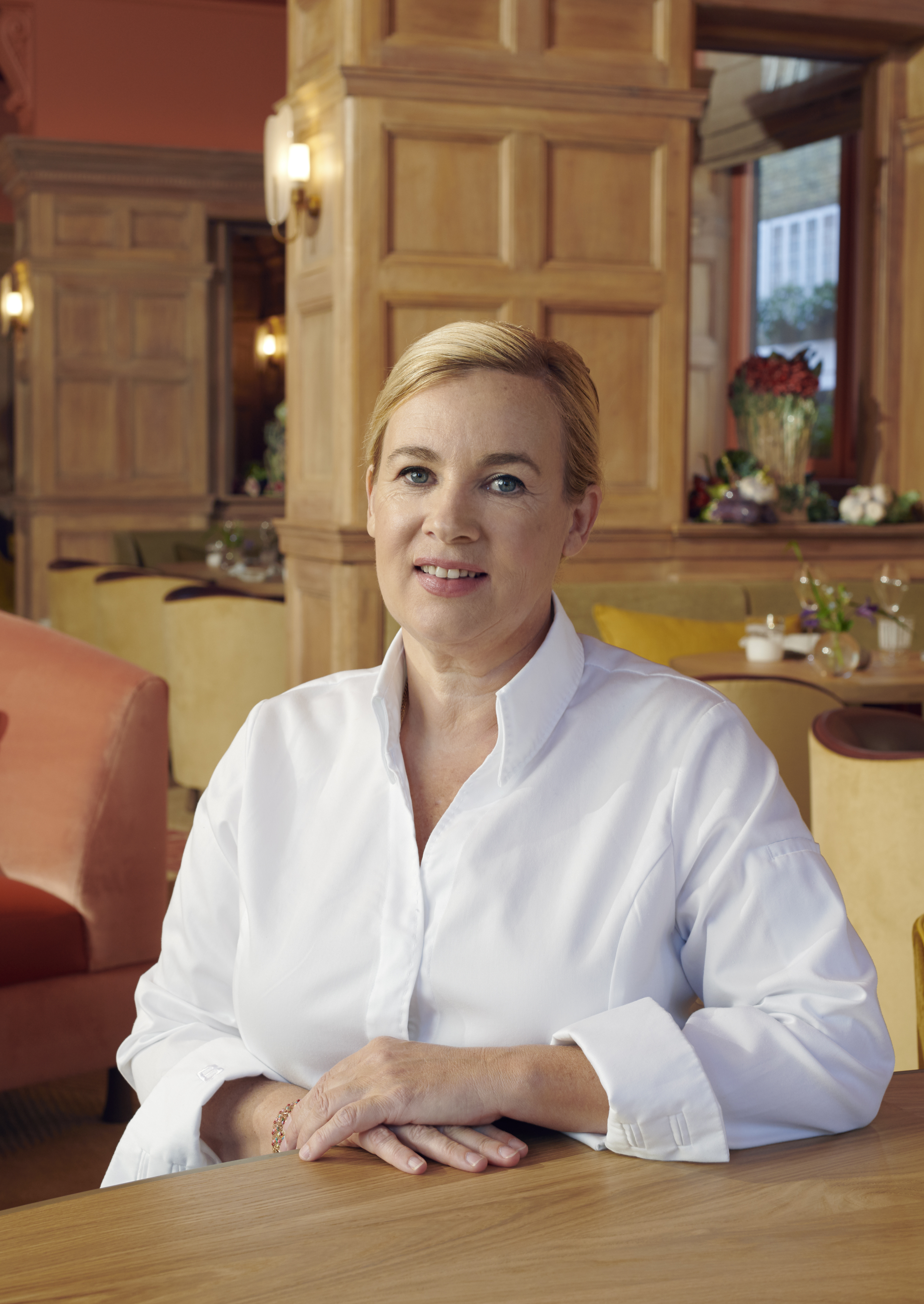
What does ambition look like when you have already reached the top? Hélène Darroze talks about Michelin, motherhood and the life she imagines after the kitchen.
Hélène Darroze is speaking to me from an office at The Connaught in London. Behind her, pinned to the wall, is a photograph collage of babies: her daughters, Charlotte and Quitterie, her nephew, fragments of a family life that has travelled with her through a career spent between kitchens, hotels and airports.
The photographs are an unexpectedly intimate backdrop for someone whose working day moves at a relentless clip. That morning alone, she has worked on menus for London and Royal Mansour in Marrakech with her executive chef, discussed the reinvention of Jòia, her casual Paris bistro, sat through communications meetings, planned an off-site event for 40 guests and gone through budgets with The Connaught’s management. Later, there will be service.
She has only just returned from three weeks travelling through Malaysia, Cambodia and Vietnam. When I jokingly suggest if she spent two months away, which is an atypical French summer, Darroze laughs.
“Two months? It’s impossible for me.”
Life at the top
That, perhaps, is the contradiction at the heart of Hélène Darroze today. Born in Mont-de-Marsan in the Landes, Hélène Darroze is the fourth generation of a family of cooks. After graduating from business school in Bordeaux, she joined Alain Ducasse at Le Louis XV in Monaco, where she spent three years before moving into the kitchen at his encouragement. She opened her first eponymous restaurant on Paris’s Left Bank in 1999. Twenty years later, she completed reinvention of the space, re-opening it in May 2019 as Marsan par Hélène Darroze, a more explicit homage to her South-Western roots.
Since then she has accumulated the things chefs are trained to want: restaurants, recognition, television fame, becoming a household name and Michelin stars, including three at Hélène Darroze at The Connaught and two at Marsan in Paris. In Marrakech, she also oversees La Grande Brasserie and La Grande Table Marocaine at the Royal Mansour, extending her reach into North Africa while adapting her cooking to local produce and traditions. The female character Colette in Ratatouille was even modelled in part after her. Yet recognition has brought her neither stillness nor any obvious desire to stop.


Ask what makes her happiest, however, and the answer is disarmingly uncomplicated.
“My biggest happiness is when I am in the kitchen,” she says. “When I share time with my team, and after, when I share time with the guests.”
In Paris, she still works the pass herself when she is there. In London, that responsibility belongs to Marco, her right hand man, although she remains present at service, checking dishes and spending time with the brigade.
“I have to be in the restaurant,” she says. “It makes sense. And once again, it also gives me a sense of happiness.”
That attachment is visible in her cooking. Marsan remains her most autobiographical expression: a restaurant built around the memories, products and spirit of the South-West of France.
There is Landes foie gras, produce from Saint-Jean-de-Luz, Basque cheeses and Armagnac. The most evocative gesture comes with the duck, roasted à la goutte de sang and finished au capucin, a technique Darroze has described as ancestral. The capucin itself is an almost medieval-looking iron implement: a long handle ending in a perforated cone, heated until scorching before fat is placed inside, ignites and rains down over the meat, crisping and perfuming it with smoke.
It encapsulates what Marsan does best: taking the cooking of hearth, family and terroir and placing it inside the vocabulary of contemporary haute cuisine, without polishing away the elemental pleasure of fire, fat and flavour.
But she is careful to distinguish those roots from a formula that can simply be exported elsewhere.
“In London, I feel obliged as a sign of respect — to cook with the products that I find in the UK,” she says. Morocco demands the same sensitivity. What travels is not necessarily the ingredient, but an approach: strong flavours, respect for produce, cooking that gathers people around a table.


“My biggest happiness is when I am in the kitchen.”
Some memories, however, do travel
On Marsan’s menu is a dish pairing lobster with tandoori spices, a preparation whose origins stretch back to a solo trip Darroze made to India in 2008. It was a consequential journey, she says, during which she questioned aspects of her life and made important personal decisions. When she returned, she created the sauce almost instinctively, originally serving it with langoustine. Nearly two decades later, variants still appear across her restaurants.
“It follows me all the time,” she says.
If food carries memory forward, ambition works differently. When I ask what remains to chase after so much success, Darroze initially resists the premise. Success, in her worldview, is not a permanent state.
“Success is never achieved,” she says. “Every day is a new day and every day you have to question yourself, to try to do better.”
There is, however, one accolade she allows herself to desire.
“If I’m really honest, my dream would be to have three Michelin stars in Paris also,” she says.
Not because she spends each morning thinking about Michelin, she insists. Marsan matters because it is hers in a way that her other restaurants are not. It is the restaurant she created as an homage to her family, her roots and the landscape that she grew up in and still occupies her imagination.
The distinction is revealing. The Connaught’s three stars demonstrate what Darroze can achieve at the highest level with the resources of a grand hotel. Marsan is more personal. London has a team of roughly 60, she says, compared with around 40 in Paris, and a hotel structure that brings far greater operational support.
A third star at Marsan would therefore mean something different. “For my family,” she says, it would be “the cherry on the cake”.
Yet even as Darroze admits to wanting another summit, she is beginning to imagine life beyond the climb.
“One day I will retire,” she says, with a sigh. “My life as a chef is very… ‘involving’, it’s very tiring. It’s a lot of work.”

She imagines beginning to step back sometime between the age of 65 and 70, although she immediately qualifies the word retirement. Perhaps she will retain one restaurant as a consultant. What she wants most is time: to travel properly, to pursue humanitarian work involving women and children and, above all, to write — books about food and cuisine, certainly, but perhaps other things too.
There is already one book waiting for her.
Darroze began writing it around 15 years ago, when her daughters were still children. One day, one of them asked her to draw a salsify because she did not know what the vegetable looked like. Darroze attempted the drawing and, by her own assessment, produced “a piece of shit”.
So she took her daughter to see the real thing.
That moment became an idea for a book structured around three gardens: that of Darroze’s great-grandfather, her grandfather and Mario Muratore, an Italian chef she worked with under Alain Ducasse and remembers as being like a second father. Through 56 fruits and vegetables, Darroze imagined a dialogue with Charlotte and Quitterie: what each plant is, where it came from, what memories it holds and how they might cook it together.
She completed only 16 entries before work consumed the time required to continue. Her publisher still asks her to return to it.
“I need time to write,” she says. “I need to have a clear mind.”
The daughters in those photographs behind her are no longer babies. Charlotte is 19, Quitterie is 17. Darroze adopted both from Vietnam and raised them as a single mother, building an extraordinary career by keeping them close. Charlotte is named after Darroze’s grandmother, a figure she describes as hugely important to her; Quitterie is a rare name from the Landes, another small act of connection to home.
When the girls were young, Darroze designed her life around proximity. Their school was near her restaurants. She chose homes within a five-minute walk of work. In London, they spent evenings in this very office: one asleep in a buggy, the other reading, drawing or watching something on the computer while their mother worked nearby.


“I never had to make a choice” between motherhood and the kitchen, she says. Then she adds the line that makes the hierarchy clear: “They were, and they will always be, my priority.”
For someone whose career has been built around restaurants, it is striking how much of Darroze’s imagined future exists outside them.
She still considers new opportunities. She still dreams, occasionally, about New York, a city she has long loved, although Asia increasingly intrigues her. And she still wants that third star in Paris.
But accumulation no longer seems to be the point. She is not dreaming of an empire of restaurants à la Joel Robuchon or an ever-expanding constellation of stars. What she talks about instead is time: time to write, time to travel, time to give back, time to finish a story begun with her daughters in a garden.
Perhaps that is what ambition looks like after the summit. Not the absence of hunger, but a change in its direction.
For now, Darroze is still at the pass in Paris. There are dishes to test, guests to feed, teams to lead, another service ahead. Success, she insists, can disappear “in one minute”, which is why the work never quite feels finished.
But somewhere in her future sits an unfinished manuscript, 40 fruits and vegetables still waiting to be written.
And perhaps, eventually, enough time to finish it.

Read more of our conversations here.